Former U.S. President Donald Trump has announced a new and detailed policy proposal aimed at regulating social media platforms operating across the United States. According to the announcement, the policy focuses on accountability, transparency, national security, and restoring public trust in digital platforms that have become deeply embedded in everyday life.
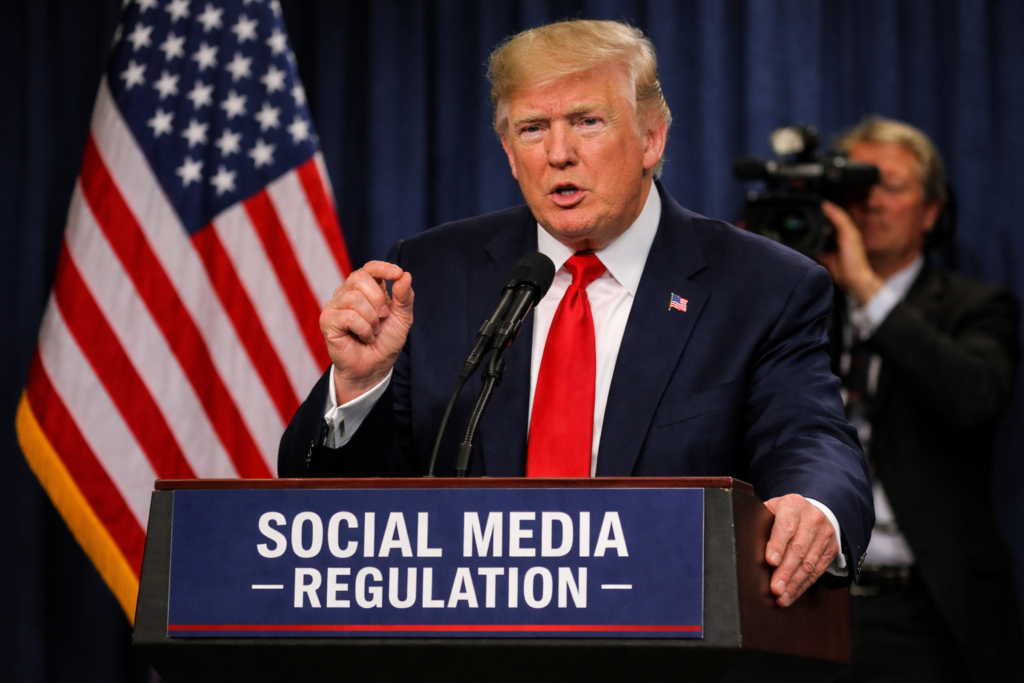
During a public address, Trump stated that social media companies have grown “too powerful and too unaccountable,” influencing public opinion, political debate, and even national conversations without sufficient oversight. He argued that while social media once promised free expression and open dialogue, it has increasingly become a space filled with misinformation, fake identities, and hidden influence.
Trump emphasized that the goal of the policy is not to silence voices but to “clean up the digital space” and make social media safer, more transparent, and more responsible for everyone.
The Growing Influence of Social Media
Over the past decade, social media platforms have transformed the way people communicate, share news, and form opinions. What started as tools for connection have now become powerful channels for political messaging, advertising, activism, and public debate.
Trump pointed out that social media platforms now shape elections, public movements, and even international narratives. According to him, such power should come with responsibility. He criticized existing laws, calling them outdated and incapable of handling the speed and scale of modern digital platforms.
He claimed that governments around the world are already moving toward stricter digital regulations, and the United States must not fall behind in protecting its citizens online.
Why Trump Says Regulation Is Necessary
In his announcement, Trump listed several reasons why he believes regulation is urgently needed:
- The rise of fake accounts and automated bots
- Rapid spread of misleading or false information
- Foreign interference in domestic discussions
- Lack of transparency in content algorithms
- Weak accountability for platform decisions
According to Trump, these issues have damaged public trust and created confusion among users. He argued that people deserve to know who is speaking, why certain content goes viral, and how their data is being used.
Inside Trump’s Proposed Social Media Policy
1. Mandatory User Identity Verification
One of the most discussed aspects of the proposal is mandatory identity verification. Under this policy, social media companies would be required to verify user accounts using official identification.
Trump claimed this step would dramatically reduce fake profiles, anonymous harassment, and coordinated misinformation campaigns. He stated that while users may still choose display names, platforms must know the real identity behind each account.
Supporters argue this could create a more civil online environment, while critics worry about privacy and data misuse.
2. Stronger Content Responsibility Rules
The policy proposes strict responsibility guidelines for content moderation. Platforms would be required to review reported content within a specific time frame, especially content related to public safety, elections, or national security.
Trump stated that platforms should not benefit financially from harmful or misleading content while avoiding responsibility. According to the proposal, repeated failure to act could result in fines or legal action.
Another major focus of the policy is algorithm transparency. Trump argued that social media algorithms silently shape what people see, believe, and discuss.
Under the proposal, platforms would be required to explain how their algorithms prioritize trending topics, political posts, and viral content. This information would be reviewed by an independent authority to ensure fairness and accountability.
Trump claimed that hidden algorithms represent a “digital black box” that must be opened.
4. Data Storage Within the United States
The policy also addresses data security by requiring U.S. user data to be stored domestically. Trump stated that storing data overseas increases the risk of foreign surveillance and cyber threats.
By keeping data within national borders, the policy aims to strengthen privacy protections and give regulators greater control over data practices.
5. Creation of a Federal Digital Oversight Authority
To enforce these rules, the proposal includes the creation of a Federal Digital Oversight Authority. This body would be responsible for monitoring compliance, conducting audits, and investigating complaints against social media companies.
According to the announcement, the authority would operate independently and focus solely on digital platforms and online communication systems.
6. Strict Penalties for Non-Compliance
Trump emphasized that regulations without enforcement are meaningless. Under the proposal, companies that fail to comply could face heavy financial penalties, restrictions on operations, or temporary suspension within the U.S. market.
He stated that penalties must be strong enough to ensure that companies take the rules seriously rather than treating fines as routine expenses.
7. Protection of Free Speech
Addressing criticism directly, Trump insisted that the policy includes strong safeguards for free speech. He claimed the intention is not censorship but accountability.
The proposal outlines appeal mechanisms and independent reviews to ensure legitimate opinions are not unfairly removed or restricted.
Public Reaction to the Announcement
The announcement quickly sparked widespread debate online. Supporters praised the proposal, saying it could reduce chaos and improve trust in digital platforms. Many users expressed frustration with fake accounts and misleading content and welcomed stricter rules.
Critics, however, raised concerns about privacy, surveillance, and government overreach. Civil liberties groups questioned whether mandatory identity verification could discourage free expression.
Technology companies also expressed concerns about the cost and complexity of implementing such changes.
Impact on the Tech Industry
If implemented, the policy could significantly reshape the tech industry. Large platforms may be able to adapt, but smaller companies could struggle with compliance costs.
Experts believe such regulations could lead to global changes, as other countries may adopt similar frameworks if the U.S. moves forward.
Legal and Constitutional Questions
Legal experts have debated whether such a policy would face constitutional challenges. Issues related to free speech, privacy, and federal authority would likely be tested in courts.
Trump acknowledged these challenges but argued that modern problems require modern solutions.
A Broader Global Trend
The proposal fits into a larger global trend toward digital regulation. Countries around the world are exploring ways to control misinformation, protect user data, and hold tech companies accountable.
Trump stated that the U.S. should lead rather than follow in shaping the future of digital governance.
Conclusion
Donald Trump’s proposed policy to regulate social media platforms presents a bold and controversial vision for the future of online communication in the United States. While supporters see it as a necessary step toward accountability and safety, critics warn of risks to privacy and free expression.
Whether realistic or not, the announcement highlights the growing concern over the power of social media and the urgent need for meaningful discussion about how digital spaces should be governed.